

In today’s retail environment, understanding where your customers come from is no longer enough. The real opportunity lies in understanding why they move, how often they visit, and which competitors they also frequent.
Using Taptap’s Retail Origins solution, we help brands win their market by analysing and activating visitor mobility with precision.
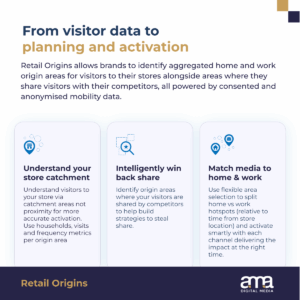
The journey moves from visitor data to planning and activation, transforming mobility insights into measurable retail performance.
Moving Beyond “Proximity” to True Catchment Strategy
Traditionally, retail media strategies have relied heavily on proximity targeting, serving ads to people near a store. But proximity does not equal loyalty, nor does it reveal opportunity.
Retail Origins allows brands to identify aggregated home and work origin areas of store visitors. Instead of asking, “Who is nearby right now?”, we ask:
- Where do your shoppers live?
- Where do they work?
- How frequently do they visit?
- Which competitor stores do they also visit?
By analysing anonymised movement patterns over time, we define true store catchment areas, not based on arbitrary radius circles, but on real-world behaviour.
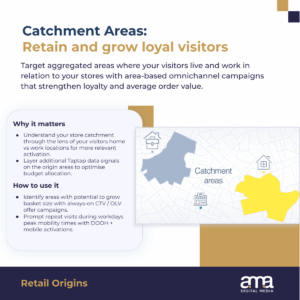
Brands can:
- Understand households, visits and frequency per origin area
- Split home vs. work hotspots
- Activate media intelligently based on time and context
This enables area-based omnichannel campaigns that strengthen loyalty and increase average order value.
Privacy-First Retail Mobility in South Africa
One of the most common questions in the market is around trust, particularly in relation to bidstream data.
Historically, bidstream data (generated during the real-time ad bidding process) has faced scepticism due to signal noise, inaccurate GPS pings and potential fraud. In isolation, that concern is valid.
However, the market has evolved.
In South Africa, Taptap uses a hybrid, privacy-first mobility data model:
1. Longitudinal SDK Data (High-Quality App Signals)
Movement data from consented mobile applications tracked over time allows us to understand patterns, not just one-off moments. This is critical in distinguishing between a genuine store visitor and someone merely passing by.
2. Refined Geo-Inferred Bidstream Intelligence
We do not rely blindly on bidstream signals. Instead, they are filtered through advanced quality checks and machine learning models that remove inaccurate or fraudulent pings.
If a signal suggests impossible movement (e.g., 50km in seconds), it is discarded. This verification engine ensures only credible mobility patterns are used for campaign strategy.
3. Full Anonymity Through Aggregation
All data is aggregated into sufficiently large geographic zones (e.g., geohash structures) to ensure that no individual is ever identifiable. We analyse the area “pulse”, not personal identity, fully aligned with POPIA regulations.
So, does the market trust bidstream data today?
On its own, perhaps not entirely. But when combined with high-quality SDK data, filtered rigorously, and used within a privacy-first aggregation framework, it becomes a powerful scalability layer, delivering both precision and reach.
The key is not the data source alone, but the quality control, validation, and strategic application behind it.
Competitive Conquesting: Winning Share from the Right Areas
One of the most powerful applications of Retail Origins is competitive area analysis

We identify origin areas where your visitors are shared with competitors and map where competitors are “winning” visits.
This allows brands to:
- Pinpoint high-opportunity conquest zones
- Prioritise budget toward the biggest win-back opportunities
- Deploy switcher messaging (price, promo, value differentiation)
- Align channel mix with real-life mobility behaviour
Instead of casting a wide net, brands can focus investment where competitive pressure is highest and opportunity is most tangible.
From Insight to Activation
Retail mobility data is only valuable if it drives action.
Retail Origins bridges analysis with activation by enabling:
- Always-on CTV and OLV campaigns targeting high-potential home areas
- DOOH and mobile activations during peak workday mobility times
- Proximity activations around complementary brand POIs
- Cross-brand partnership identification
As demonstrated in the “Understand Store Visitation Behaviour” framework
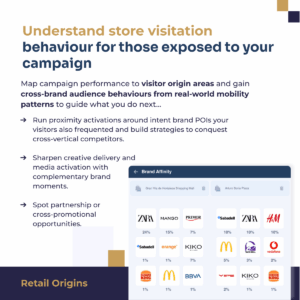
Campaign performance can be mapped back to visitor origin areas, providing a feedback loop that sharpens future strategy.
This is where retail mobility becomes performance-driven media.
The Future of Retail Strategy in South Africa
In an economy where every Rand must justify itself, retail mobility data provides a strategic advantage:
- More accurate catchment modelling
- Smarter budget allocation
- Competitive win-back strategy
- Measurable store visitation impact
Mobility data is no longer just about tracking footfall. It is about understanding the intent behind movement and influencing the journey before it reaches the point of sale.
At A.M.A Digital Media, we believe the brands that win in South Africa will be those that combine privacy-first technology, validated data models, and intelligent activation.
Retail is no longer about location alone.
It is about origin, overlap, and opportunity.
To unlock the full potential of retail mobility data and start turning catchment insights into measurable competitive advantage, contact us today to discuss how Retail Origins can power your next performance-driven retail campaign.